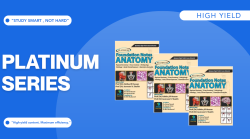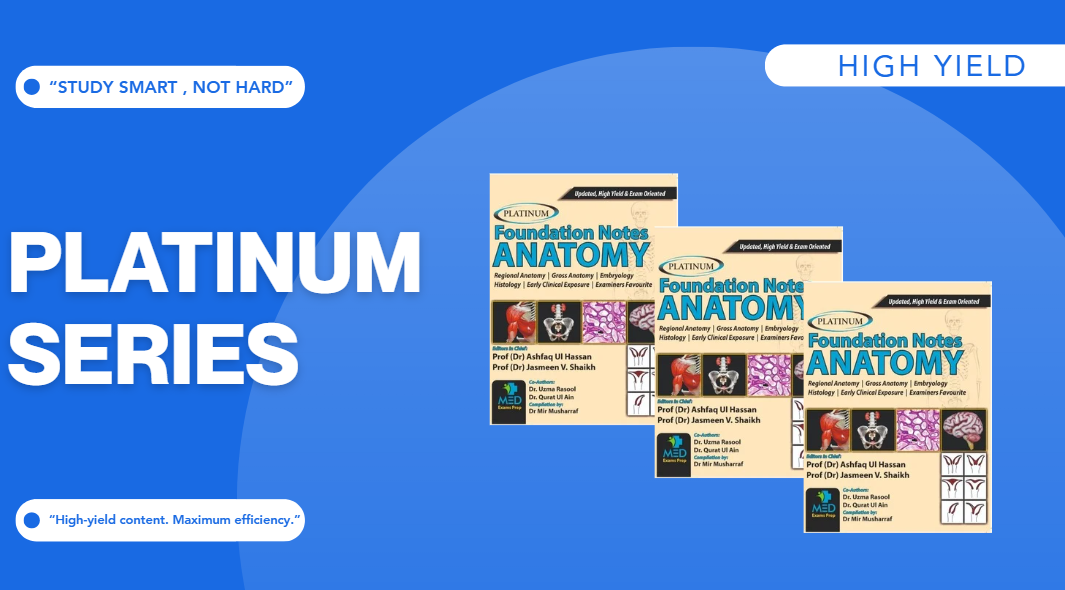
Platinum Foundation Notes Anatomy : Redefining the Way Medical Students Learn Anatomy
A Modern Companion for Every First-Year MBBS Student
"The physician who understands anatomy does not merely memorise the human body; they understand the blueprint of life itself."
The first subject for every physician is anatomy. It serves as the introduction to the structure of the human body and transforms curiosity into the knowledge required to function effectively as a medical practitioner. For example, it provides you with insight into your ability to identify tiny nerves within the brachial plexus or congenital abnormalities during embryology. Therefore, anatomy is at the heart of every area of medicine.
Despite the importance of anatomy, it is historically perceived as one of the most difficult aspects of the MBBS programme. This is not unexpected because the anatomy syllabus is extensive, has confusing terminology, requires an abundance of diagrams, and encompasses numerous examination types, including practicals (both viva and written).
To assist future physicians in overcoming their difficulties associated with anatomy studies, Platinum Foundation Notes Anatomy was designed as a high-yield, student-friendly tool to simplify the learning process without compromising scientific accuracy. This resource is far more than just a typical anatomy textbook; it has been chosen with careful thought to serve as a significant learning resource. This book is the result of years of teaching experience, academic excellence, and a genuine commitment to improving medical education.
More Than Just Notes—A Complete Learning System
The last 10 years have been transformative for the field of medical education. Today's medical student is now preparing for their university examination as well as preparing for their competitive exams (e.g., NEET PG, FMGE, INI-CET, NExT, USMLE, PLAB) simultaneously. Textbooks will continue to be a resource that is extremely valuable for students. Due to the sheer volume of material, however, many medical students have difficulty with the amount of information that is included in traditional textbooks.
Therefore, during exams, many medical students are looking for concise, concept-based materials that will allow them to quickly review for their exam while also retaining all of the information that they need. Platinum Foundation Notes Anatomy is a remarkable resource for filling this need. Each chapter in the book is very carefully organized and structured to assist students in progressing from basic concepts to clinical applications. By using this structure, learning will be logical, enjoyable, and oriented toward the completion of examinations.
The book provides all of the students' needs in one complete package, bridging the gap between vast reference books and quick revision guides by including:
- Concise explanations
- High-yield facts
- Logical flowcharts
- Comparative tables
- Clear diagrams
- Clinical correlations
- Exam-oriented questions
Comprehensive Coverage of Every Essential Topic
One of the book's strongest aspects is its balanced coverage of every important area of anatomy. Students will find detailed yet simplified discussions on:
- Regional Anatomy: Comprehensive breakdown of the human body by specific regions.
- Gross Anatomy: Clear descriptions of structures visible to the naked eye.
- Histology: Microscopic structure of tissues with easy-to-reproduce diagrams.
- Embryology: Step-by-step developmental stages and congenital anomalies.
- Early Clinical Exposure (ECE): Early integration of clinical settings into foundational learning.
- Applied Anatomy: Real-world medical and surgical applications of anatomical structures.
- Frequently Asked Examination Topics: Core questions targeted for university success.
- High-Yield Revision Points: Bulleted summaries for rapid recall before test day.
Click here for all Latest Books https://amazon.in/s?me=A1O5F7XR1CIVU8&ref=sf_seller_app_share_new
Instead of presenting isolated facts, the book encourages conceptual understanding. Each chapter builds naturally upon previous knowledge, allowing students to appreciate the relationships between structures rather than merely memorising names.
Learning Made Simpler: Overcoming Information Overload
Medical students often describe anatomy as "information overload." This book addresses that challenge by presenting complex information in an organised, visually appealing, and reader-friendly manner. Important concepts are explained using a multifaceted pedagogical approach:
[Complex Anatomical Data]
├─► Simplified Language & Logical Sequencing
├─► Easy-to-Remember Tables & Memory Aids
└─► Clear Illustrations & Concise Summaries
The result is a book that students can confidently study throughout the academic year as well as during last-minute revision before examinations. It respects the limited time of medical students while maximizing their learning outcomes.
Where Anatomy Meets Clinical Medicine
One of the defining strengths of Platinum Foundation Notes Anatomy is its emphasis on clinical relevance. The authors understand that anatomy should never be studied in isolation. Throughout the book, anatomical concepts are linked with real clinical situations, including:
- Common nerve injuries: Understanding wrist drop, claw hand, and foot drop through neurological pathways.
- Fractures: Correlating bone breaks (like Colles' or femoral neck fractures) with adjacent vascular risks.
- Surgical landmarks: Identifying safe zones for incisions, injections, and lumbar punctures.
- Hernias: Mapping the boundaries of the inguinal canal and femoral ring.
- Developmental abnormalities: Visualizing atrial septal defects and cleft palate origins.
- Surface anatomy: Mastering projection lines for internal organs on the living body.
- Radiological interpretation: Reading basic X-rays, CT scans, and MRI planes confidently.
- Clinical examination findings: Linking physical signs to deep structural pathology.
This integrated approach helps students appreciate why anatomical knowledge remains indispensable throughout medical practice.
Designed for Competency-Based Medical Education (CBME)
The Competency-Based Medical Education (CBME) curriculum has transformed undergraduate medical teaching across the globe. Students are now expected not only to remember anatomical structures but also to apply their knowledge in clinical settings.
Platinum Foundation Notes Anatomy aligns perfectly with these modern educational goals by integrating:
- Conceptual learning: Focusing on the 'why' and 'how' behind anatomical structures.
- Clinical reasoning: Developing diagnostic thinking from day one.
- Practical anatomy: Streamlining concepts for dissection hall discussions and spotters.
- Early clinical exposure: Blurring the lines between preclinical theory and clinical practice.
- Examination preparation: Providing structured text that matches university evaluation patterns.
This makes the book equally valuable for classroom learning, dissection hall discussions, practical viva-voce examinations, and long-term preparation for postgraduate entrance exams.
Authored by Distinguished Medical Educators
The greatest strength of any academic book lies in the experience and vision of its authors. Platinum Foundation Notes Anatomy has been authored and edited by educators who have dedicated their professional lives to teaching anatomy and mentoring thousands of medical students.
Prof. (Dr.) Ashfaq Ul Hassan
At the heart of this remarkable work is Prof. (Dr.) Ashfaq Ul Hassan, one of the most respected anatomy educators, known for his innovative teaching methods and student-centric approach. For years, Dr. Ashfaq Ul Hassan has guided undergraduate and postgraduate aspirants through classroom teaching, academic mentorship, and digital education. His ability to simplify even the most complex anatomical concepts has earned him the admiration of thousands of medical students.
His philosophy is simple yet powerful: medical education should focus on understanding rather than rote memorisation. This philosophy is reflected throughout the book. Every chapter demonstrates careful attention to conceptual clarity, examination relevance, and clinical integration. Students who have attended his lectures often appreciate his ability to convert difficult topics into simple, memorable learning experiences—and this same teaching style is evident in every page of the book. His contribution extends beyond traditional classrooms, inspiring learners through digital educational initiatives and helping students prepare confidently for university and competitive examinations alike.
Prof. (Dr.) Jasmeen V. Shaikh
Co-editor Prof. (Dr.) Jasmeen V. Shaikh brings extensive academic expertise and years of experience in anatomy education. Her contribution ensures that the book maintains scientific accuracy while remaining accessible to students beginning their medical journey. The systematic organisation of topics, emphasis on conceptual understanding, and student-friendly presentation reflect her commitment to excellence in medical education. Together, both editors have created a resource that successfully balances academic depth with practical simplicity.
Valuable Contributions from Expert Collaborators
The academic excellence of this book has been further enhanced by the addition of Dr. Uzma Rasool and Dr. Qurat Ul Ain, who provide updated theory, practical usage, and exam-oriented content, adding vital expertise to the content of the book.
It must be noted that Dr. Mir Musharraf provided support via conceptual editing and collecting material to ensure that all material was presented consistently and clearly to create a smooth learning experience for the reader. The combined efforts of all of these individuals have resulted in a common goal of making Anatomy easier, better understood, and more enjoyable to all medical students regardless of ethnicity or gender.
A Book That Grows With the Student
Unlike books that are useful only during the first professional year, Platinum Foundation Notes Anatomy remains relevant throughout a medical student's academic journey. Students often revisit anatomy during:
First Year MBBS ──► Second Year Path/Pharma ──► Clinical Postings (Surgery/Ortho) ──► Internships & PG Exams (NEET PG/NExT)
- Second Professional MBBS: Understanding structural vulnerabilities to pathogens and drugs.
- Surgery postings: Navigating surgical planes, triangles, and access paths.
- Orthopaedics: Reviewing joint mechanics, ligaments, and bone morphology.
- Obstetrics & Gynaecology: Mastering pelvic anatomy, perineal planes, and foetal development.
- Radiology: Correlating cross-sectional anatomy with advanced imaging scans.
- Anaesthesia: Mapping nerve plexuses for targeted regional nerve blocks.
- Internship: Applying emergency bedside anatomy for procedures like chest tube insertions.
- Postgraduate Prep: Solving high-yield MCQ patterns for NEET PG, FMGE, and NExT.
Because the content focuses on concepts rather than superficial memorisation, the book continues to serve as an effective revision guide even years after first reading it.
Why Students Appreciate This Book: Key Takeaways
Medical students consistently value resources that respect their limited time while maximizing learning outcomes. Some of the standout qualities of this text include:
- Student-friendly language: Breaks down complex medical jargon into readable text.
- High-yield examination content: Minimizes fluff, focusing on topics likely to be tested.
- Comprehensive yet concise explanations: Offers deep understanding without bulkiness.
- Excellent clinical correlations: Connects theory directly to patient care scenarios.
- Easy-to-revise format: Uses visual break-outs, making it perfect for rapid review sessions.
- Logical chapter organization: Helps the brain map information sequentially.
- Concept-based learning: Prioritizes active cognitive understanding over raw memorization.
Preparing Students for the Future of Medicine
Medicine is constantly evolving. New technologies, advanced imaging techniques, minimally invasive surgeries, and precision medicine all continue to reinforce one timeless truth—a doctor can never outgrow anatomy. Whether interpreting MRI images, performing laparoscopic surgery, administering regional anaesthesia, or examining a patient at the bedside, anatomical knowledge remains the foundation of safe and effective clinical practice.
Books that merely help students pass examinations serve a temporary purpose. Books that build lifelong understanding become trusted companions throughout a medical career. Platinum Foundation Notes Anatomy belongs to the latter category.
Final Thoughts
A great medical textbook does more than present information—it inspires confidence, encourages curiosity, and transforms complex subjects into meaningful knowledge. Platinum Foundation Notes Anatomy succeeds in doing exactly that.
Through its carefully organized content, clinical orientation, examination-focused approach, and commitment to conceptual clarity, the book has established itself as an invaluable resource for MBBS students and aspiring medical professionals. Behind its pages stands the dedication of distinguished educators whose shared mission is to make anatomy accessible, engaging, and relevant for every learner.
For students stepping into the fascinating world of medicine, this book is far more than a collection of notes. It is a trusted mentor in print—guiding them from the first anatomy lecture to the threshold of clinical excellence. In a discipline where understanding the human body is the first step toward healing it, this book provides exactly what every medical student needs: a strong foundation, a clear direction, and the confidence to succeed.
Click to : Purchase here